Pages

Friday, December 19, 2008

BONDING SINGAPORE Chapter 5 Notes Sec 3 textbook


Notes page 1


Notes page 2


Mindmap on Measures to foster social cohesion ins Singapore


Inclusive notes: 

Building a national Identity (I)

- policy of multi-racialism
-Policy of multi-racialism promotes equality among races
-No special rights for any racial/religious groups.
-Equal opportunities for all.
-Favouring one racial/religious group is forbidden by constitution.
-Since everyone is seen as a valued member, this fosters a sense of national identity.

Building A national Identity (II)

-Common Practices
-Common practices are actions that singaporeans carry out together.

Example: Singing the national Anthem, saying the pledge and attending flag raising ceramony.

These practices help to foster natonal identity by inculcating loyality & national pride towards Singapore.

These practices help Singaporeans to see themselves as one people. 

Builiding a national Identity (III)

Bilingualism

-Policy of Bilingualism was introduced in 1966
-All pupils have to learn English and mother tongue
-English is seen as a neutral language linking various ethnic groups. The use of english has helped to improve communication among Singaporeans
-Mother Tongue is used to impart Moral values and traditions of each race.
-The policy of Bilingualism helps to foster national Identity between the various racial/religious groups.

Safeguarding Interests of Minority groups (I)

Through Minority Representation

-President council of minority rights(PCMR)
-All new laws must be approved by PCMR

-This ensure no racial/religious groups is disadvantaged by the laws passed.

-Group Representation Consituency

-GRCs ensures that any team contesting in general Election must comprise a member from a minority group( Malay, Indian or Eurasian)

-This ensures that minority group is represented in the government.

-Needs and concers of minority group are reflected in government.

Safeguarding Interests of Minority groups (II)

Through Self-help Groups

-CDAC, Mendaki, SINDA & Eurasian Association help members of their own community to get aids in studies and training of their own jobs.

-Provide Moral support to members of their own cimmunity.

-Help Singaporeans to cope and compete with one another on equal footing.

-Minority groups can improve their economic and social positions in society.

-Joint projects - e.g. Joint Tuiton Program help youths from different ethnic groups interact with one another.

-This helps to prevent Bias & Prejudices from forming, thus reducing conflict and tension.

Developing Common Space(I) 

-Activites organised by grassroots organisations 

-Create common space through wide range of programs and activities to cater to the needs & interests of singaporeans.

Example. Home visits/home stay with family of another ethnic group.

This helps the people to gain better understanding of cultures and customs of other races.

This helps to build strong friendships over time and reduces mistrust between racial/religious groups.

Developing Common space (II)

Opportunities from Educational Institutions 

- All schools are open to every singaporean, regardless of race, language or religion.

-Students of different race and religion study together.

-Daily Interaction during lessons and activities provide opportunities for students.

-CCAs also help promote closer bonds among youths. These activities provide opportunities for students from various races to work together.This helps to promote teamwork.

Developing Common Space (III)

Common Living Space through Public Housing

-In 1989, Ethnic Integration Policy was introduced in public housing.

-Limits are placed on the proportion of races in every neighbourhood and block.

-This ensures an even distribution of different races in all housing estates.

-This provides opportunities for various races to interact , reducing distrust and misunderstanding among races.

Developing Common Space(IV)

Activities organised by IRCCS and HCs

-IRCC(Inter-Racial Confidence circles) and Harmony Circles (HCs)

-IRCCs were introduced in 2002 to foster greater inter-racial understanding.

-Activities such as visits to places of worship create opportunities for singaporeans to appreciate the differences and develop string bonds between ethnic groups.

-At Workplaces, such activities are carried out by HCs.

-These activities help to build confidence and friendship among people.

Developing Common Space (V)

Shared Experience through National Service (NS) 

-NS was introduced in 1967.

-All able-bodied men are required to serve in defence of the country.

-Shared experiences (example, Military training) help to strengthen the bonds among ben regardless of race or religion.

STRUCTURED ESSAY QUESTIONS ON BONDING SINGAPORE( PRACTICE)

1.) Here are 3 measures to foster social cohesion in Singapore. Common Practices, Shared experience through NS and Self-help groups. Which measure do you think is the most effective. Explain your answer. (13 marks)

2.) How far do you agree that the most important measure to foster a national identity is through the policy of multi-racialism.
Explain your answer. (12 marks) 

Thursday, December 18, 2008

Working with Sources- Evaluating usefulness Worksheet

All sources can be useful. When we receive information from sources, we many need to determine how useful information is to us. To do this, we need to know what the information is used for. then, we can ask some questions to help us determine the usefulness of the source.

Provenance/origin

-WHO made the statement?
Does the author/speaker have any motive for making the statement? What outcome is he/she trying to achieve?

How does it make the source useful or not?

Cross Reference

Who else can I find the Information from?

Content

What information does the source provide about the issue?
----------------------------------------------------------------------------------
Study Source A. How useful is the Source A in helping you understand the factors that help to develop a sense of belonging among Singaporeans? Explain your answer.

Source A  

A comment by Mayor Amy Khor South West District, on what would make Singaporeans care about Singapore.

The job of making Singaporeans feel and realize that they love the nation never really ends. Just as flim-makers use camera and audio techniques to create the mood- be it horror, tension serenity, anger or pain- We need to create the mood by having more collective rituals: National Day Celebrations, Special commerative events, National Song Contests and the like, to prompt this sense of belonging, if not necessary love.

What is the information used for? (What is the issue?) 


Reliability Skill Chart


reliability skill chart 


Structured Essay Revision Practice

Chapter 2-Governance in Singapore

1.) The vehicle Quota System (VQS) is the most important measure in keeping traffic flow smooth in singapore. How far do you agree with the statement?
Explain your answer. [12]

2.) Here are three guiding principles of governance in Singapore:

Leadership is Key
Anticipating change and staying Relevant
reward for Work and Work for Reward

Which do you think is the most important prniciple? Explain your answer. [13]

3.) To what extent is ageing population the most important reason why there was a need to promote population growth from the 1980s? Explain your answer. [12]

4.) Here are three strategies the government used to promote population growth after the 1980s.

Graduate Mothers Scheme
Three or more if you can afford it
Pro-Family Measures(2004)

Which do you think is the most effective? Explain your answer.[13]

5.) "Government support is the most important approach in managing the ageing population in singapore". How far do you agree with the statement? Explain your answer. [12]

Chapter 4-Conflict in Multi-ethnic Societies

6.) "The Sinhala Only policy was the most important cause of the conflict between the sinhalese and Tamils in Sri lanka". How far do you agree with the statement? Explain your answer. [12]

7.) Here are the three causes of conflict between the Sinhalese and tamils in Sri Lanka:
Citizenship rights
university Admission
Resettlement of poor Sinhalese Peasants

Which do you think is the most important cause of the conflict? Explain your answer.[13]

8.) To what extent is armed conflict the most important consequence of the conflict between the Sinhalese and tamils in Sri Lanka? Explain you answer. [12]

9.) Here are the three causes of conflict between the Protestants and Catholics in Nothern Ireland:
Divided Loyalties
Unequal Allocation of housing
Lack of voting rights
Which do you think is the most impt cause of the conflict? Explain your answer. [13]

10.) "Economic slowdown is the most serious consequence of the conflict between the Protestants and Catholics in Northern Ireland". How far do you agree with the statement? Explain you answer.

Chapter 5-Bonding Singapore

11.) Here are three challenges that could affect harmony in multi-ethnic Singapore:
Perceptions of dfferent racial groups
Perceptions of different religious group
External Influences
Which do you think is the most serious challenge? Explain your answer. [13]

12.) "Building a national Identity is the most important measure to manage ethnic diveristy in Singapore". How far do you agree with this statement? Explain your answer. [12]

Tuesday, December 16, 2008

Social Studies Skill Practice reliability 2


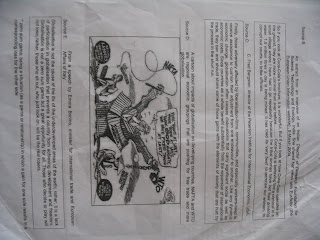
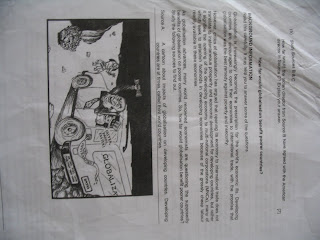
Social Studies Skill Practice Reliability Topic: Globalisation


Social Studies Skill Practice Reliability Topic: Globalisation


INSTRUCTIONS: PRINT OUT THE DOCUMENT AND PRACTICE ON YOUR SS.

REMEMBER! PRACTICE MAKES PERFECT. 

Victoria School Prelim Paper 2 SS 2008


Structured Essays Page 5


Page 4 


Page 3 Sources


Page 2 BACKGROUND INFORMATION


PAge 1 is the questions

Section A (source Based Questions Case study)

Question 1 is compulsory for all candidates

Study the background information and the sources carefully. and then answer all the questions.

You may use any of the sources to help you answer the questions. In addition to those you are told to use. In answering the questions you should use your knowledge of the topic to help you interpret and evaluate the sources.

1a) Study source A.

What is the message of the cartoon? Explain your answer, using details of the cartoon. [5]

1b) Study Source B and C.

How far would the Iraqi Foreign Minister in Source B have agreed with Assistant Secretary of State in Source C? Explain your answer. [6]

1c) Study Source D

How useful is this source as evidence about kuwait's role in the conflict with Iraq?
Explain your answer. [7]

1d) Study Source E.
How far does this source prove that the United States was responsible for the outbreak of the Iraq-Kuwait War? Explain your answer. [7]